


From elopements and Airbnb weddings to venues and National Park ceremonies, here’s how couples actually get married in Joshua Tree—and how to decide what fits.
Joshua Tree isn’t a one-size-fits-all wedding destination—and assuming it is usually leads to confusion fast.
There are multiple ways to get married in Joshua Tree, and the experience can feel completely different depending on two early decisions: what kind of wedding you’re having and where it takes place. Some couples elope. Others plan a destination wedding with guests. Some want a quiet, low-key day. Others want a full wedding weekend.
Then there’s the location piece.
In Joshua Tree, most weddings fall into a few main paths:
you can host an Airbnb wedding, get married at a Joshua Tree wedding venue, or have a permitted ceremony inside Joshua Tree National Park. Each option comes with different rules, logistics, guest considerations, and overall pace for the day.
This also isn’t a banquet-hall kind of place. While traditional event spaces technically exist, they’re not how most couples choose to get married here. Joshua Tree weddings are usually outdoors, hosted at homes or hospitality-style properties, or structured around short, intentional ceremonies—especially in the park.
This post is a big-picture overview of your real options for getting married in Joshua Tree. Not what you should do—just how each option actually works, what it’s best suited for, and how to choose the path that fits your priorities instead of forcing your day into a mold that doesn’t.
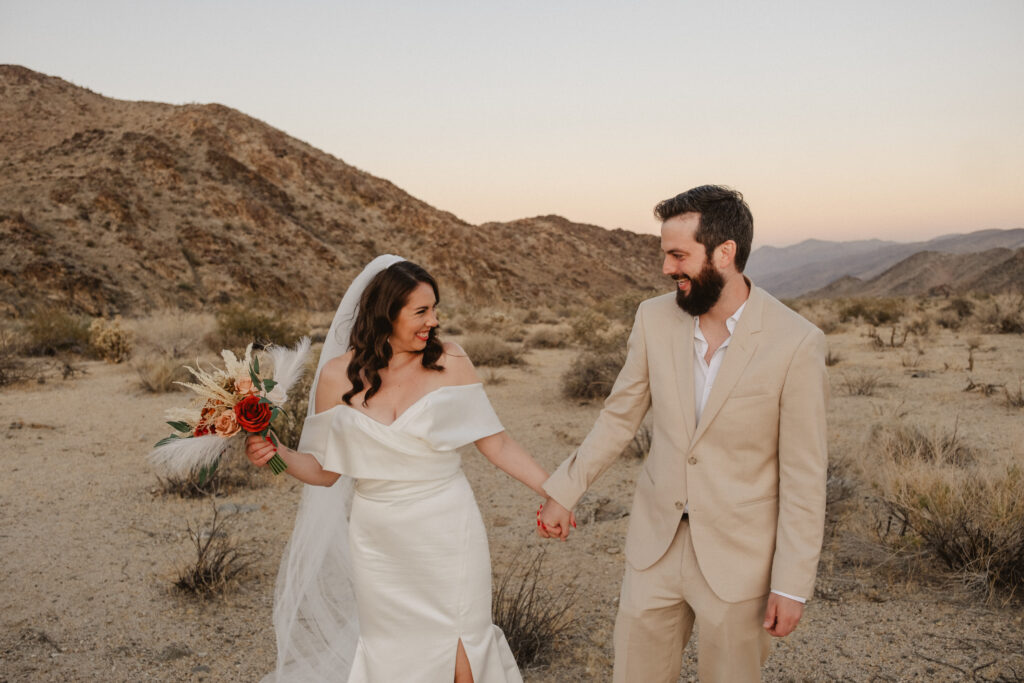
Elope in Joshua Tree
A flexible, experience-first way to get married in Joshua Tree—without turning your day into a production.
When couples talk about eloping in Joshua Tree, they’re usually talking about keeping things small, intentional, and low-pressure. That might mean just the two of you, or it might include a handful of guests—but the common thread is that the day isn’t built around hosting or managing a crowd.
Eloping doesn’t automatically mean hiking, chasing light, or packing your day with movement. Some elopements are quiet and stationary; some are slow and relaxed; and some involve very little photography at all. The real decision isn’t how adventurous your elopement looks—it’s how active or hands-off you want your day to be, and how much of it you want documented versus simply lived.
Joshua Tree elopements are often chosen because they allow for:
- Fewer logistics and fewer rules
- More flexibility in timing and pace
- A calmer experience that doesn’t revolve around a strict schedule
This is also where terms like micro elopement start to come up. You don’t need to sort that out immediately, but it’s helpful to know that elopements in Joshua Tree can exist on a spectrum—from very simple ceremonies to slightly more structured, guest-inclusive days that still prioritize ease over production.
Eloping works especially well for couples who want their wedding day to feel grounded, unhurried, and centered on the experience itself—not on managing vendors, timelines, or expectations that don’t actually matter to them.
Joshua Tree Airbnb Wedding
A popular one-location option—when the space supports the day instead of fighting it.
Airbnb weddings are one of the most common ways couples get married in Joshua Tree, mostly because they promise simplicity: one location, familiar surroundings, and the ability to gather everyone in one place. When they work, they work really well. When they don’t, it’s usually because expectations outpace what the property is actually set up to handle.
The first thing to know is that not all Airbnbs allow events. Some properties prohibit weddings entirely. Others allow events but restrict guest numbers, require advance approval, or only allow guests who are staying on the property. Policies vary widely, even between homes that look similar online, so this is something that needs to be confirmed early—before you build a plan around the space.
Airbnb weddings in Joshua Tree tend to work best when:
- The guest list is small
- Most or all guests are staying on-site
- The day stays simple and uncompressed
- The house is treated like a home, not a venue
This setup often creates a relaxed, intimate feel—especially when everyone is sharing meals, downtime, and the pace of the weekend together.
Where Airbnb weddings start to feel harder is when the event size outweighs the space. As guest counts grow, logistics grow with them: parking, noise, timing, rentals, vendors cycling in and out. At a certain point, the house is being asked to function like a traditional wedding venue, which is usually when stress creeps in and flexibility disappears.
From a photography and experience standpoint, one-location Airbnb weddings can be incredibly smooth. There’s no rushing between locations, no travel buffer to manage, and no pressure to fit everything into a narrow window. The day tends to unfold naturally—especially when couples plan around comfort and presence rather than production value.
An Airbnb wedding is a strong choice in Joshua Tree when the space supports the scale of your day, your guests, and the way you actually want to spend your time. When those things align, it can feel effortless. When they don’t, it’s often worth reconsidering the structure before locking anything in.

Joshua Tree Wedding Venues
Joshua Tree wedding venues are outdoor-focused spaces that balance guest experience, accommodations, and logistics—without the ballroom vibe.
Joshua Tree wedding venues don’t function like traditional banquet halls. This isn’t a “pick a ballroom, add linens, call it a day” kind of place. Most venues here are outdoor-forward, experience-driven, and shaped by the desert environment rather than built to override it.
Broadly speaking, Joshua Tree wedding venues tend to fall into a few functional categories:
Some are private event homes—essentially houses that allow weddings. These often include on-site accommodations for a limited number of guests and may offer beautiful ceremony setups, open desert views, or thoughtfully designed gathering spaces. Others function more like hospitality-style venues, where lodging and event space coexist and the wedding becomes part of a larger, weekend-style experience. There are also event-only venues, where the celebration happens on-site but guests stay elsewhere.
What’s important to understand early on is that, in Joshua Tree, event capacity and accommodation capacity are rarely the same thing.
Most venues can host more people than they can house overnight. That means couples usually end up making one of two intentional choices:
- An intimate wedding weekend, where the guest list stays small enough for everyone—or nearly everyone—to stay on-site together
- A destination wedding weekend, where the couple and a core group (often immediate family or the wedding party) stay at the venue, and additional guests find nearby accommodations
Neither option is better than the other. They simply create different experiences. One emphasizes shared time and closeness. The other allows for a larger guest list while still keeping the heart of the weekend centered in one place.
Some hospitality-style venues in the Joshua Tree area—such as Reset Hotel, AutoCamp, or Field Station—are commonly chosen by couples hosting larger guest counts because they’re structurally designed to support more people moving through the space. Even then, it’s typical for some guests to stay off-site, and transportation and timing still play an important role in how the day flows.
Venue weddings in Joshua Tree tend to work best for couples who want a bit more structure than an elopement or Airbnb wedding, while still embracing the reality that desert weddings are shaped by space, sound, light, and environment. When expectations are aligned with how the venue actually functions, these weddings can feel grounded, intentional, and surprisingly relaxed.

Joshua Tree National Park Wedding
A permit-based option with designated locations, clear limitations, and a very defined scope.
You can get married inside Joshua Tree National Park, but National Park weddings here are far more limited than many couples initially expect.
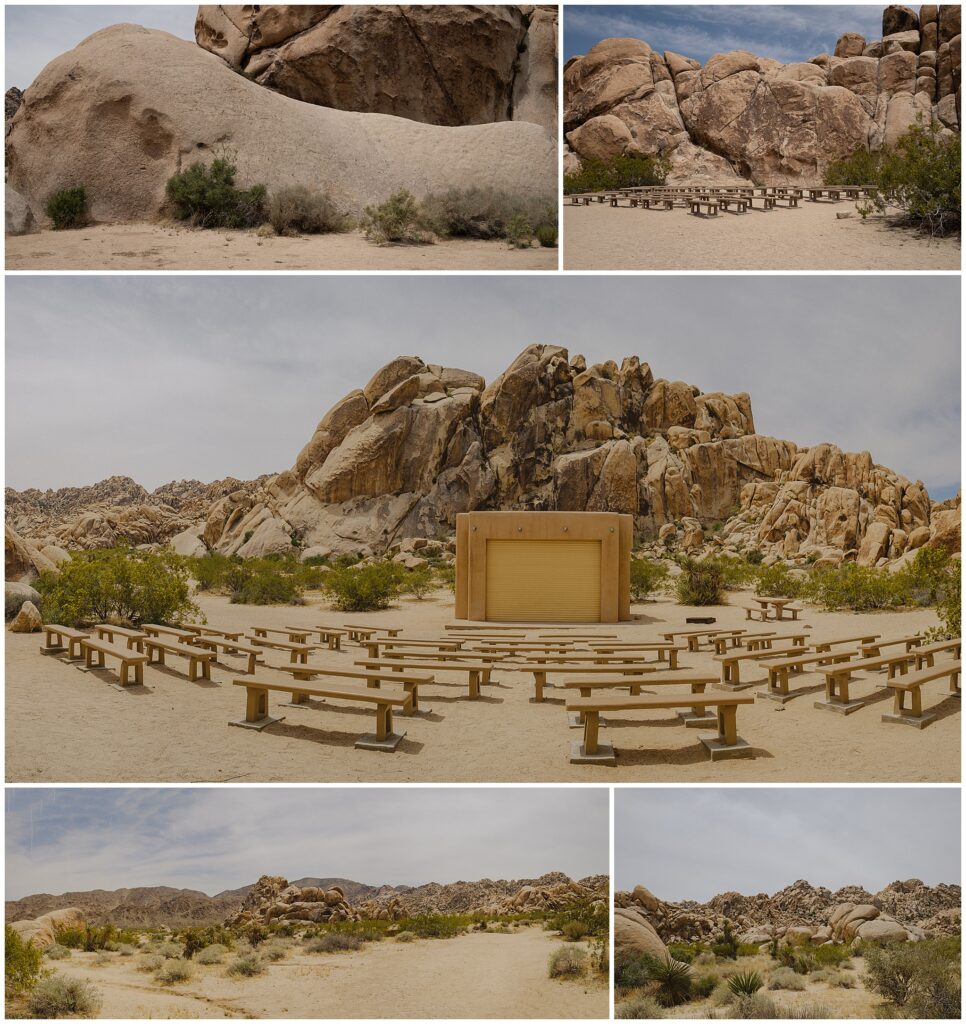
Ceremonies are allowed by permit only and must take place at specific, designated locations within the park within a set timeframe. These ceremonies are designed to be short, low-impact moments, not full wedding days. There’s no décor, no furniture, no amplified sound, and no moving between locations during the ceremony itself. These rules are in place to protect the park and reduce visitor impact, and they’re enforced consistently.
Most ceremony sites within the park are best suited for very small guest counts and brief ceremonies. Each location has its own guest limit, accessibility considerations, and seasonal restrictions, which is why it’s important to understand how the ceremony sites differ before choosing one. I break these locations down in more detail in my Joshua Tree wedding locations guide, which is a helpful starting point when exploring National Park options.
Outside of one notable exception, National Park weddings in Joshua Tree are generally ideal for couples who want a simple, contained ceremony that stands on its own—often followed by portraits or a meal elsewhere once the ceremony concludes.
That exception is Indian Cove.
Indian Cove is part of Joshua Tree National Park, but it isn’t accessed from inside the park proper. It’s located at the end of a residential neighborhood just off Highway 62, which changes how logistics work. Indian Cove is also the only National Park ceremony location that can accommodate a larger guest count.
That said, Indian Cove comes with its own constraints. Only one vehicle is allowed at the ceremony site, which means guests must be shuttled in and out together. It’s also seasonally restricted and not available for weddings during the warmer months of the year. These factors make it a good fit for some couples, but logistically complex for others.
For most couples, a Joshua Tree National Park wedding works best when it’s approached as a meaningful moment within a protected landscape, rather than the foundation for an entire wedding day. When expectations are aligned with what the park allows, the experience can feel simple, grounded, and deeply intentional.
Choosing What Fits Your Wedding Day
It’s less about the location—and more about how you want the day to feel.
By this point, it’s probably clear that there isn’t one “right” way to get married in Joshua Tree. Elopements, Airbnb weddings, venue-based celebrations, and National Park ceremonies all exist for a reason. The key difference isn’t which option looks best on paper—it’s how each one shapes your experience.
Most of the meaningful decisions come down to a few practical considerations:
How many people you want to host versus how many you want to be fully present with.
Whether you want your day to feel slow and spacious or more structured and social.
How much energy you want to spend managing logistics versus simply being in the moment.
Whether staying together on-site matters more than accommodating a larger guest list.
Joshua Tree tends to reward clarity. When couples choose a wedding structure that aligns with their priorities—rather than forcing a day to fit expectations that don’t actually apply here—the experience almost always feels easier, calmer, and more intentional.
There’s no version of a Joshua Tree wedding that’s inherently better than another. The best choice is the one that supports how you want to spend your time, who you want around you, and what you want to remember about the day once it’s over.


